
Every owner exits. Most just don't get to decide when, how, or for how much.
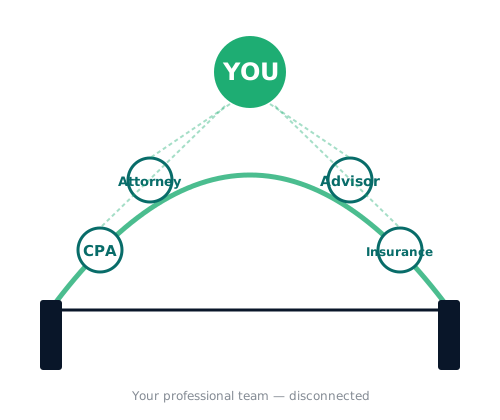
Your CPA, your attorney, and your financial advisor are each solving one-third of the problem. Nobody’s solving the whole thing. We change that.
The numbers tell a story most owners would rather not hear.
of owners who sold regretted it within one year. Not because the deal was bad — because nobody planned what came next.
of owners planning to exit within five years have completed a valuation. The rest are protecting themselves from a number.
of millionaires don’t use a financial advisor. The confidence that built their wealth tells them not to protect it.
"Doing nothing feels safe because nobody can blame you for it. But the IRS doesn't grade on intentions. Inaction is a decision — it's just the only one where you never see the invoice."
The numbers tell a story most owners would rather not hear.
Your CPA, your attorney, and your financial advisor are each solving one-third of the problem. Nobody’s solving the whole thing. We change that.
01 Process Complexity
Exit planning is maximally unfamiliar terrain. You do it once. The vocabulary is foreign. The option set is enormous. The path of least resistance is always ‘not now.’
“I need to think about it.”
02 Self-Perception
The confidence that built an eight-figure business whispers ‘you don’t need help.’ High performers believe they’ll recognize the exact moment help becomes necessary — and reliably identify it only after damage is done.
“I’ve got it handled.”
03 Relationship & Trust
Only 44% of investors trust financial services firms to act in their best interest. The more elegant your proposal looks, the more the alarm rings: ‘this person profits from my yes.’
“My CPA has it covered.”
04 Decision Architecture
Losses hurt twice as much as gains feel good. The gains of planning are abstract and future. The losses — control, familiarity, the comfort of not deciding — are concrete and immediate.
“Going a different direction.”
05 Identity & Mortality
For most founders, the business isn’t something they own — it’s who they are. Choosing a successor forces them to confront that the world will go on without them. Exit planning is estate planning’s cousin.
Silence. Cancelled meetings.
"Doing nothing feels safe because nobody can blame you for it. But the IRS doesn't grade on intentions. Inaction is a decision — it's just the only one where you never see the invoice."
You have advisors. You don't have a plan.
- Your business generates $300K+ in EBITDA and you know it's worth more than what a buyer would offer today
- You have a CPA, an attorney, maybe a financial advisor — but they've never been in the same room together
- You've been 'planning to plan' your exit for years, but the complexity keeps you in place
- You suspect your business is too dependent on you, and that's suppressing its value
- You want to exit on your terms — not because a health event, market shift, or burnout forces your hand
A structured path from where you are to where you want to be.
11 workshops. 3-4 months. Each one designed to answer a specific question about your business, your readiness, and your future — delivered by a coordinated team, not a single advisor working alone.
Readiness Assessment
ComplimentaryEvaluate your preparedness across multiple dimensions. Identify where you stand today.
Transition Objectives
Capture your personal, financial, and business objectives. Define what success looks like for you.
Business Analysis
Compare your business to industry metrics. Identify where value is being left on the table.
Owner Reliance
Assess how dependent the business is on you. Identify opportunities to reduce that dependency and increase value.
Planning Valuation
Get an indication of business value based on your actual financial information.
Wealth Gap Analysis
Determine whether a gap exists between what you need and what the business can deliver.
Value Enhancement
Analyze every operational area for opportunities to enhance value before you go to market.
Stakeholder Alignment
Ensure all stakeholders are aligned with your transition objectives. This step alone transforms outcomes.
Business Continuity
Document how the business operates without you. Buyers pay more for businesses that don't need their founder.
Asset Protection
Review current measures protecting your personal and business assets. Identify vulnerabilities.
Buyer Type & Deal Structure
Examine buyer types and deal implications. Third-party sale vs. internal transition — each has different consequences.
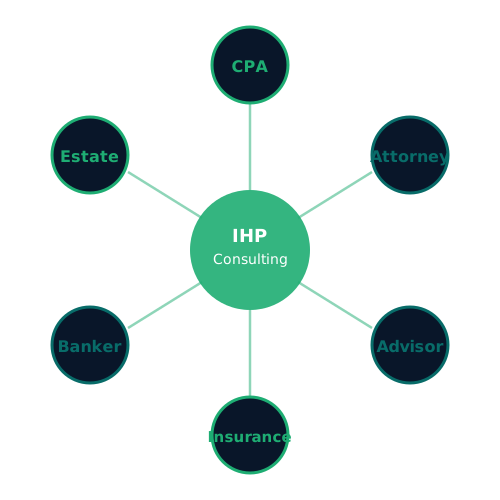
We're not here to replace anyone on your team.
We’re here to make sure the people you already trust are actually talking to each other — because right now your CPA, your attorney, and your financial advisor are each optimizing one-third of your life and nobody’s watching the whole board.
- Your existing advisors stay in place
- We coordinate the strategy across all disciplines
- One plan, one timeline, one team — finally aligned
The 11-Step Exit Readiness Roadmap
A comprehensive guide to the structured assessment process that takes business owners from “I should probably think about this” to “I know exactly what my business is worth, what it could be worth, and how to close the gap.”
Download the Framework
PDF guide — no spam, just the roadmap.
Exit Readiness Assessment
Answer five questions to determine if our structured assessment process is the right fit. Takes less than two minutes.
You qualify.
Enter your details below to schedule your no-cost Exit Readiness Assessment.